
Please visit our new TrackAbout Knowledge Base at https://supportkb.trackabout.com for the most-up-to-date documentation on TrackAbout and TrackAbout Mobile.
Difference between revisions of "Asset Registration (Add New)"
m |
|||
| (18 intermediate revisions by 5 users not shown) | |||
| Line 1: | Line 1: | ||
| + | == Summary == | ||
| − | + | Registering your assets is fundamental to getting started with TrackAbout. Registration, often referred to as "Add New," is the process of tagging/barcoding your assets, collecting unique information about your assets, and entering the data into TrackAbout. | |
| − | + | TrackAbout supports registering your assets through both mobile and website tools. | |
| − | + | == Asset Collision Detection == | |
| − | TrackAbout | + | When a new cylinder is registered, TrackAbout checks whether or not it already exists to ensure that two copies of the same asset don't get created. What constitutes uniqueness can be configured to include barcode, serial number, manufacturer and/or manufacture date. |
=Registering Assets (Mobile Device)= | =Registering Assets (Mobile Device)= | ||
| Line 14: | Line 15: | ||
Required information for all TrackAbout registration processes include: | Required information for all TrackAbout registration processes include: | ||
* Barcode | * Barcode | ||
| − | * Serial Number | + | * [[Serial Number]] |
* Product Code | * Product Code | ||
* Ownership | * Ownership | ||
| − | However, to benefit from TrackAbout's inventory, reporting capabilities, business rules and workflows, we recommend you | + | However, to benefit from TrackAbout's inventory, reporting capabilities, business rules and workflows, we recommend you collect the following, too: |
*Manufacturer | *Manufacturer | ||
| Line 33: | Line 34: | ||
'''Add New - Offline''' has two different modes of operation, depending upon configuration. We call them Detailed and, well, not detailed. | '''Add New - Offline''' has two different modes of operation, depending upon configuration. We call them Detailed and, well, not detailed. | ||
| − | In '''Detailed Mode''', a single asset is added at a time and the record is saved containing just the one asset. More asset properties are collected in the Detailed mode. | + | *In '''Detailed Mode''', a single asset is added at a time and the record is saved containing just the one asset. More asset properties are collected in the Detailed mode. |
| + | |||
| + | *In '''Not-Detailed Mode''', some basic asset details are collected like classification and ownership. The user then scans multiple assets, collecting barcode and serial number data for each. | ||
| + | |||
| − | + | '''Add New with Look up (Online Mode)''' | |
| − | Add | + | Add New with Look up is TrackAbout's best practice for registration. This registration workflow allows users to first look up an asset by barcode or serial number to confirm whether the asset already exists in the system. This validation helps prevent duplicates in your system. |
| − | + | Add New Workflow | |
| − | + | #Conduct a look up by barcode OR serial number -- not both. For new assets, best practice is to do this look up by serial number to prevent collisions on duplicate serial numbers. | |
| + | #If the system finds a match, the user will be asked to review the matches and decide if you want to edit an existing asset or create a brand new one. | ||
| + | #If the system does NOT find a match, user will be asked to complete the regular Add New flow. | ||
| − | |||
| − | + | ''Save and Save and Add More (TrackAbout Mobile 7)'' | |
| − | + | '''Use Save''' when you’re adding a single asset or are done adding assets that share the same information. | |
| − | + | '''Use Save and Add More''' when you’re adding more than one of an asset and you want to use the same information for all of them. | |
| − | + | ==Physical Registration - Barcode and Tag placement== | |
| − | + | A crucial part of the registration process includes affixing a tag/barcode to the asset. | |
| + | Best practices for applying RFID tags or barcodes varies depending on the kind of asset. However, in general, you want to be sure to have a clean dry surface. Also, it's best to place the tag or barcode in a place that won't receive regular rubbing but is easy to access for scanning purposes. | ||
[[File:Placing_Barcodes.pdf|thumb|Caption text]] | [[File:Placing_Barcodes.pdf|thumb|Caption text]] | ||
| + | |||
| + | ==Registration features== | ||
| + | |||
| + | TrackAbout provides lots of options for how to configure your registration process. Some of these options are supported by add-on modules. In these cases, the required modules will be in parentheses after the feature. | ||
| + | |||
| + | * Require key fields for uniqueness. "Key Fields" include Serial Number, Manufacturer and Manufacturer Date | ||
| + | * Collect different sets of unique information based on Asset Type ([[Dynamic_Forms |Dynamic Forms]]) | ||
| + | * Register containers/pallets ([[Palletization| Palletization]]) | ||
| + | * Register Bundles/Packs | ||
| + | * Verify Barcode, Serial Number, Manufacturer Date prior to save | ||
| + | * Collect Valve Information ([[Dynamic_Forms |Dynamic Forms]]) | ||
| + | |||
| + | ==Secondary Add New== | ||
| + | |||
| + | An Add New can also be performed from within other actions. When this happens, we call it a '''Secondary Add New'''. | ||
| + | |||
| + | This scenario happens when a user is doing some other kind of action and realizes he/she needs to scan an asset with no barcode. At this time, the application allows the user to pause their current action, perform an in-line, NON-LOCATION-SETTING Add New, and then return to their original action. (Non Location Setting means the action will not change the asset's location. Where ever TrackAbout thinks this asset is at the time of the action will not change). | ||
| + | |||
| + | The application saves the Secondary Add New record a few seconds prior to the primary action. We save it before the primary action because the Add New will create and classify the asset, and we want that asset created and classified prior to the saving of the primary action. The Secondary Add New is also non-location-setting, because the primary action COULD be location setting, and we don't want to move the asset around prior to a potential location-setting action. | ||
| + | |||
| + | If an [[Key_Concepts#Accounting_Adjustments|accounting adjustment]] record is going to get created as a result of the primary action, we don't want that accounting adjustment to appear due to the Secondary Add New. We want it to appear due to the primary action.<br> | ||
=Add New Asset (Website)= | =Add New Asset (Website)= | ||
| + | Add News performed directly from the main menu are Location Setting. | ||
=Editing Asset Info (Mobile Devices)= | =Editing Asset Info (Mobile Devices)= | ||
=Editing Asset Info (Website)= | =Editing Asset Info (Website)= | ||
Latest revision as of 14:22, 20 October 2022
Summary
Registering your assets is fundamental to getting started with TrackAbout. Registration, often referred to as "Add New," is the process of tagging/barcoding your assets, collecting unique information about your assets, and entering the data into TrackAbout.
TrackAbout supports registering your assets through both mobile and website tools.
Asset Collision Detection
When a new cylinder is registered, TrackAbout checks whether or not it already exists to ensure that two copies of the same asset don't get created. What constitutes uniqueness can be configured to include barcode, serial number, manufacturer and/or manufacture date.
Registering Assets (Mobile Device)
Most clients choose to use one of our mobile options (TAM6 or Smartphone) to register their assets. During your implementation phase, you will define what pieces of unique information should be collected for each asset.
Required information for all TrackAbout registration processes include:
- Barcode
- Serial Number
- Product Code
- Ownership
However, to benefit from TrackAbout's inventory, reporting capabilities, business rules and workflows, we recommend you collect the following, too:
- Manufacturer
- Manufacturer Date
- Ownership
- Last Test Date
- Capacity (or Size)
-NOTE This type of custom asset information is collected during the registration process through the use of the Dynamic Forms module.
Online and Offline Mode
TrackAbout offers an Offline and an Online mode for Add New. This indicates whether handheld device have access to the internet (via Wifi or Cellular) when conducting Mobile Actions.
Add New - Offline has two different modes of operation, depending upon configuration. We call them Detailed and, well, not detailed.
- In Detailed Mode, a single asset is added at a time and the record is saved containing just the one asset. More asset properties are collected in the Detailed mode.
- In Not-Detailed Mode, some basic asset details are collected like classification and ownership. The user then scans multiple assets, collecting barcode and serial number data for each.
Add New with Look up (Online Mode)
Add New with Look up is TrackAbout's best practice for registration. This registration workflow allows users to first look up an asset by barcode or serial number to confirm whether the asset already exists in the system. This validation helps prevent duplicates in your system.
Add New Workflow
- Conduct a look up by barcode OR serial number -- not both. For new assets, best practice is to do this look up by serial number to prevent collisions on duplicate serial numbers.
- If the system finds a match, the user will be asked to review the matches and decide if you want to edit an existing asset or create a brand new one.
- If the system does NOT find a match, user will be asked to complete the regular Add New flow.
Save and Save and Add More (TrackAbout Mobile 7)
Use Save when you’re adding a single asset or are done adding assets that share the same information.
Use Save and Add More when you’re adding more than one of an asset and you want to use the same information for all of them.
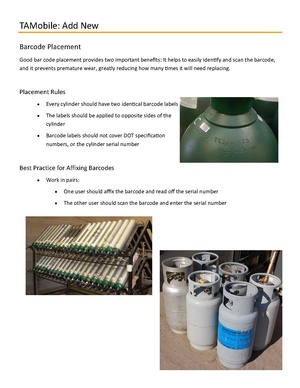
Physical Registration - Barcode and Tag placement
A crucial part of the registration process includes affixing a tag/barcode to the asset.
Best practices for applying RFID tags or barcodes varies depending on the kind of asset. However, in general, you want to be sure to have a clean dry surface. Also, it's best to place the tag or barcode in a place that won't receive regular rubbing but is easy to access for scanning purposes.
Registration features
TrackAbout provides lots of options for how to configure your registration process. Some of these options are supported by add-on modules. In these cases, the required modules will be in parentheses after the feature.
- Require key fields for uniqueness. "Key Fields" include Serial Number, Manufacturer and Manufacturer Date
- Collect different sets of unique information based on Asset Type (Dynamic Forms)
- Register containers/pallets ( Palletization)
- Register Bundles/Packs
- Verify Barcode, Serial Number, Manufacturer Date prior to save
- Collect Valve Information (Dynamic Forms)
Secondary Add New
An Add New can also be performed from within other actions. When this happens, we call it a Secondary Add New.
This scenario happens when a user is doing some other kind of action and realizes he/she needs to scan an asset with no barcode. At this time, the application allows the user to pause their current action, perform an in-line, NON-LOCATION-SETTING Add New, and then return to their original action. (Non Location Setting means the action will not change the asset's location. Where ever TrackAbout thinks this asset is at the time of the action will not change).
The application saves the Secondary Add New record a few seconds prior to the primary action. We save it before the primary action because the Add New will create and classify the asset, and we want that asset created and classified prior to the saving of the primary action. The Secondary Add New is also non-location-setting, because the primary action COULD be location setting, and we don't want to move the asset around prior to a potential location-setting action.
If an accounting adjustment record is going to get created as a result of the primary action, we don't want that accounting adjustment to appear due to the Secondary Add New. We want it to appear due to the primary action.
Add New Asset (Website)
Add News performed directly from the main menu are Location Setting.